

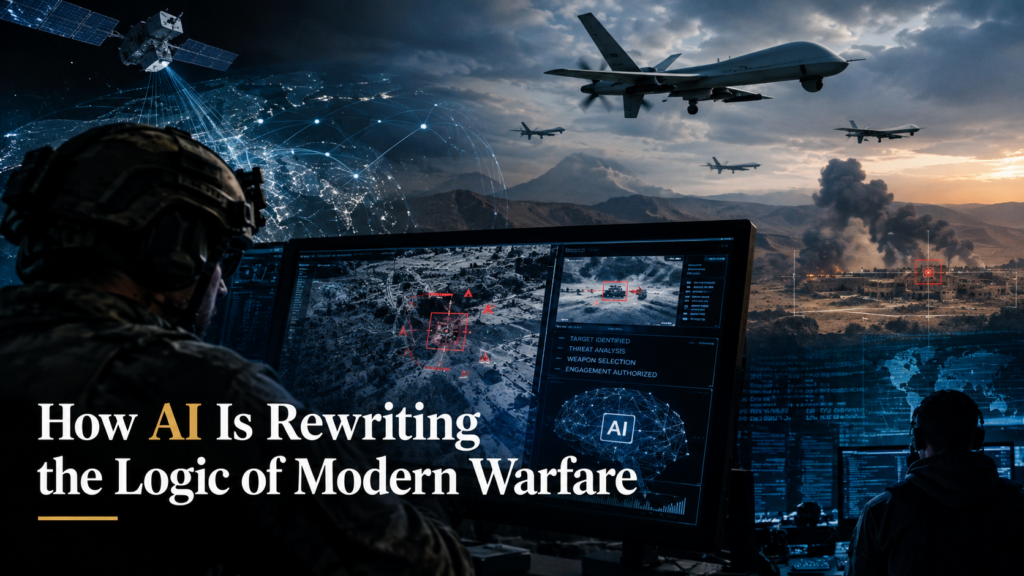
For most of modern history, military strategy has rested on a simple constraint: human decision-making takes time, and time creates room for restraint, negotiation, and de-escalation. Artificial intelligence is quietly eroding that constraint.
Autonomous targeting systems, AI-assisted early-warning networks, and algorithmic threat assessment are compressing the decision cycle in modern conflict from hours to seconds. Militaries from the United States to China are investing heavily in systems that can identify, prioritize, and in some cases engage targets with minimal human intervention. The strategic logic is straightforward: whoever decides faster, wins. But speed cuts both ways — it also shrinks the window in which a human being can say “wait.”
This is not a hypothetical concern. Reports from recent conflicts, including the war in Ukraine and Israel’s operations in Gaza, indicate AI-assisted targeting systems have already influenced real-time battlefield decisions. The danger isn’t simply that machines make mistakes — it’s that they make mistakes at a speed and scale that outpaces human oversight.
The deeper shift is conceptual. Deterrence theory, arms control, and the laws of armed conflict were all built around the assumption of a human decision-maker who can be reasoned with, deterred, or held accountable. When decisions are distributed across algorithms trained on incomplete data, that entire framework needs rethinking — not abandoning, but rebuilding for a world where the fastest actor, not necessarily the wisest one, shapes the outcome.
#AI #Modern #Warfare #Security #IR #theconvention


Leave a Reply